
Singapore Citizens seeking treatment for haze-related conditions pay no more than S$10 at polyclinics and participating GP clinics from Monday 12 October, as the Haze Subsidy Scheme returns for the first time since 2015. The Ministry of Health activated the scheme and its Public Health Preparedness Clinic (PHPC) network on Sunday 11 October.
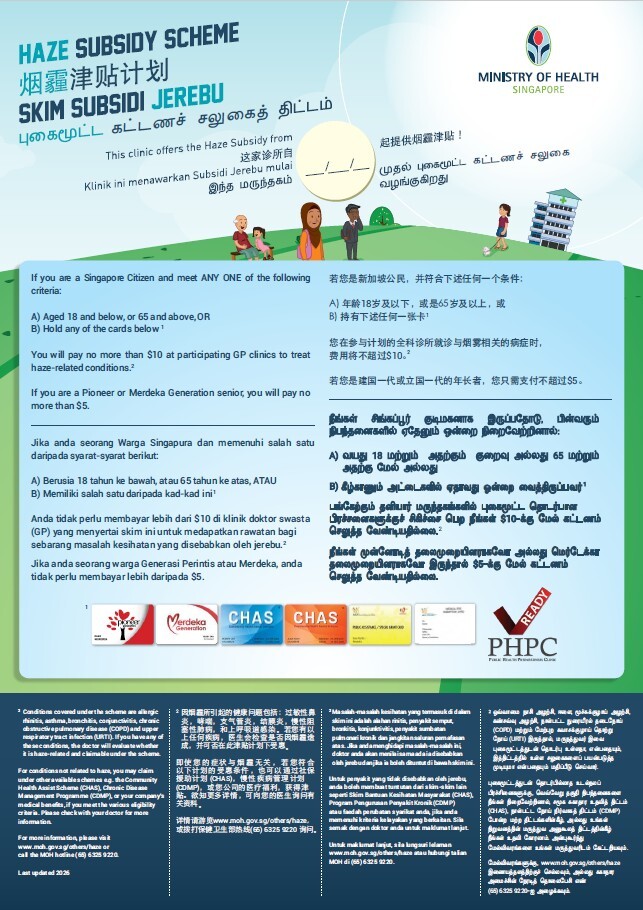
Public Assistance cardholders pay nothing. Pioneer Generation and Merdeka Generation seniors pay no more than S$5, and other eligible Singapore Citizens pay no more than S$10.
At 5am on Monday, the 24-hour PSI ranged from 105 in the north to 148 in the west and central regions. A reading of 101 and above is in the unhealthy range.
Who is covered at GP clinics
At a PHPC clinic, the subsidy is open to Singapore Citizens who meet one of these conditions:
- aged 18 and below, or 65 and above
- on Public Assistance
- Pioneer Generation or Merdeka Generation members
- Community Health Assist Scheme (CHAS) Blue or Orange cardholders
- holders of the Medical Fee Exemption Card
At polyclinics the rules are wider. Every Singapore Citizen is eligible for the subsidy at all polyclinics, whatever their age or card.
Participating clinics display a PHPC decal or the Haze Subsidy Scheme poster at the door.
Which conditions qualify
The scheme covers allergic rhinitis, asthma, bronchitis, conjunctivitis, chronic obstructive pulmonary disease and upper respiratory tract infection, along with their complications.
Conditions not related to haze fall outside the scheme. Those visits can still be claimed under other schemes such as CHAS, the Chronic Disease Management Programme or a company medical benefit.
Why the scheme is back now
Health Minister Ong Ye Kung activated the scheme at Health Fiesta 2026 on Sunday. Hospital emergency departments are seeing a week-on-week rise in patients with respiratory problems, and polyclinics are seeing more patients too.
“I think it is not just due to haze, but also because the haze season this year coincided with the Influenza A season,” Mr Ong said. He expects the haze to last for a few more weeks, as the inter-monsoon season has not changed wind or rain patterns.
Most of the 1,370 clinics in the PHPC network had agreed to take part by Sunday morning, Mr Ong said. He asked patients without serious symptoms to go to a PHPC clinic rather than an emergency department.
What hospitals are doing
Hospitals have closed windows in wards and corridors and turned on ventilators, air purifiers and spot cooling. They are also taking stock of emergency supplies, which Mr Ong described as “quite well-stocked”.
The PHPC scheme has been switched on for haze before and, more recently, for COVID-19. It links private GP clinics into one network that the Government can switch on during a health alert, and pays the clinics for the subsidised care they give.
Masks and outdoor activity
For healthy people, a few days of haze generally causes no more than irritation of the eyes, nose and throat, and N95 masks are not needed for short trips such as the commute to work or school, or indoors. Healthy people who must be outdoors for several hours can cut their exposure with a well-fitted N95 when the forecast is hazardous, above PSI 300.
The threshold is lower for the elderly, pregnant women and people with chronic heart or lung disease. They may wear an N95 mask when the forecast is very unhealthy, above PSI 200, and they have to be outdoors for several hours. Those who have difficulty breathing at rest should see a doctor before using one.