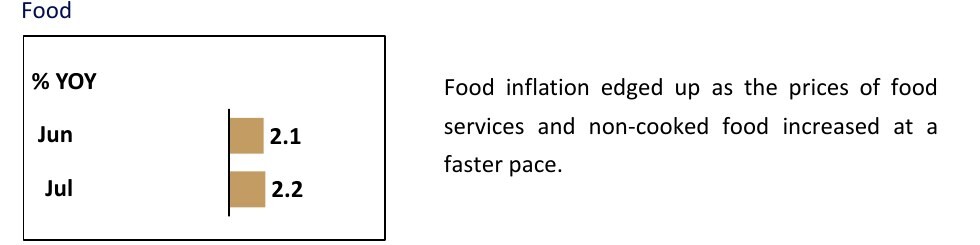
Food inflation in Singapore rose to 2.2 per cent year-on-year in July 2026, up from 2.1 per cent in June, according to the joint report from the Monetary Authority of Singapore and the Ministry of Trade and Industry, released on 24 August.
What actually went up
MAS Core Inflation, which strips out private transport and accommodation, rose to 2.0% year-on-year in July from 1.6% in June, driven by electricity and gas, services and food. Headline CPI-All Items inflation picked up to 2.2% from 1.9%. Inside that, the report’s Food category specifically climbed to 2.2% in July from 2.1% in June, which the report attributes to food services and non-cooked food prices increasing at a faster pace than the month before.
Why food is pricier now
The report’s outlook section points to two forces still working through the system: adverse weather conditions expected to lower agricultural yields and raise Singapore’s imported food prices, and elevated global energy costs passing through supply chains into a wider range of imported goods and services. Neither is specific to a single ingredient or category, which is why the 2.2% figure shows up as a broad edge-up rather than a single dramatic jump.
What this means at the hawker table or the supermarket
Because the Food category covers both food services (eating out) and non-cooked food (groceries), the 2.2% figure is not only a restaurant story. It sits behind the kind of per-100g price gaps that show up when you compare a new supermarket product against the regular version sitting next to it on the shelf, which is arithmetic worth doing at the trolley rather than assuming from the headline number alone.
What is not yet known
The July report does not break the Food category down further into hawker, restaurant, cooked or non-cooked shares, so which part of your weekly spend is actually driving the 2.2% is not visible from this release alone. MAS and MTI project both Core and CPI-All Items inflation to average 1.5–2.5% across the whole of 2026, with the risk tilted toward the upper end of that range rather than the lower.
Food really did get 2.2 per cent pricier over the year to July, and Singapore’s own outlook expects further increases before any easing.
Details
Source: Monetary Authority of Singapore and Ministry of Trade and Industry,
“Consumer Price Developments in July 2026”, released 24 August 2026.
The next release, covering August 2026 data, is due from MAS and MTI in the following month.